Let’s be honest — dealing with taxes is not exactly how most moms want to spend their free time. Between school runs, grocery trips, and keeping the household together, the last thing you need is a confusing tax process hanging over your head.
But if you own a car in Germany, the Kfz-Steuer (vehicle tax) is something you simply cannot ignore. The good news? It is actually a lot more manageable than it sounds — especially once you know what you are dealing with and where to find help.
Here is a simple, no-fuss guide to help you get through it calmly.
What Exactly Is Car Tax in Germany?
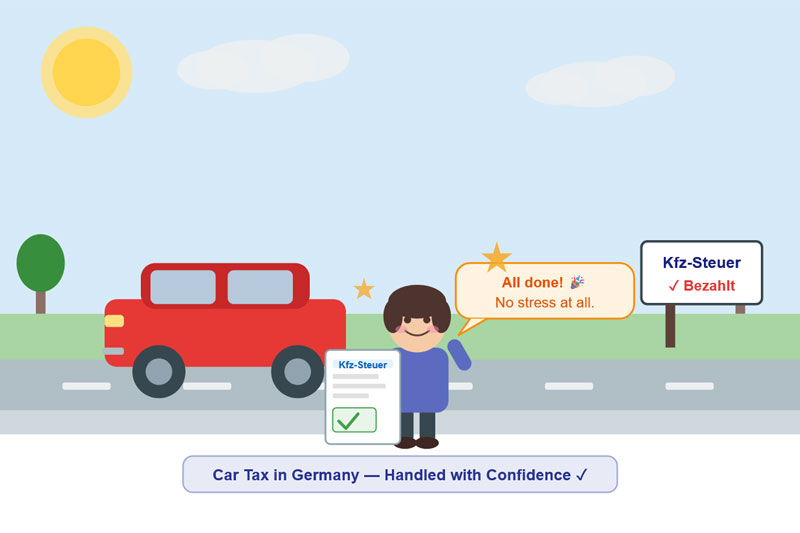
Car tax, or Kfz-Steuer, is an annual tax that every car owner in Germany has to pay. It is not a one-time thing — it renews automatically each year and is directly linked to your vehicle registration.
The amount you pay depends on a few things:
- The type of engine — whether it is a petrol, diesel, electric, or hybrid car
- Engine size — measured in cubic centimetres (cc)
- How much CO₂ your car emits — the more it emits, the higher the tax
- When your car was first registered — older cars are taxed differently than newer ones
Good news for electric car owners: electric vehicles in Germany are currently exempt from Kfz-Steuer for a period of time, so if you drive one, you may not owe anything at all right now.
Who Collects the Tax and How Does It Get Paid?
The Hauptzollamt (Customs Office) is the authority responsible for vehicle tax in Germany. When you register your car, they automatically set up the tax for you. The payment is usually collected directly from your bank account via SEPA direct debit, so you do not have to remember to make a manual payment every year.
This is actually one of the easier parts — once it is set up, it mostly runs in the background.
How Do You Know How Much You Owe?
This is where a lot of people feel confused, but it does not have to be. A tax calculator Germany tool is the quickest way to get a rough estimate of your annual car tax before anything becomes official.
You can find a reliable one on the ADAC website (one of Germany’s biggest automobile clubs) or through the Zoll.de official portal. All you need to enter is your car’s engine type, engine size, and CO₂ emissions — information that is right there on your vehicle registration document (Fahrzeugschein).
Using a tax calculator Germany tool takes less than five minutes and gives you a clear picture of what to expect. No guesswork, no unpleasant surprises.
Real Talk: What Happens If You Do Not Pay?
If the direct debit fails — maybe because your account details changed or there were insufficient funds — the Customs Office will contact you. You will get a reminder, and if it still goes unpaid, late fees and even penalties can follow.
As a busy mom, the last thing you want is a letter from the government about an overdue tax bill. So it is worth double-checking that your bank details are up to date, especially if you have recently changed accounts.
You can update your banking information directly with the Hauptzollamt by filling out a SEPA mandate form — your local customs office can walk you through it, or you can do it online.
Common Situations Moms Often Wonder About
“I just bought a new car — do I have to do anything?”
When you register the car at the Zulassungsstelle (vehicle registration office), the vehicle tax is automatically registered at the same time. They will send you a tax assessment letter, and payments will be taken from the bank account you provide.
“I sold my car halfway through the year — do I get money back?”
Yes! Car tax is calculated on a pro-rata basis. If you sell or deregister your car before the year is up, you will get a refund for the months you no longer owned the vehicle. You do not have to do anything extra — the system handles it once the car is officially deregistered.
“My car is older and uses a lot of fuel — will I pay more?”
Possibly, yes. Older petrol and especially diesel cars with higher CO₂ emissions do tend to attract higher tax rates. This is part of Germany’s push to encourage greener vehicles. If your car falls into this category, a tax calculator Germany tool will give you an honest figure so you can plan your budget accordingly.
“Can I get any exemptions or discounts?”
There are some exemptions available — for example, if a family member has a registered disability, you may be eligible for a reduced rate or full exemption on the vehicle used for their transport. This requires an application with the right documentation, but it is worth looking into if it applies to your household.
Tips to Keep It Stress-Free
Keep your registration document somewhere accessible. You will need the CO₂ figures and engine details every time you want to check your tax or use an online calculator.
Set up a reminder once a year. Even though the tax is automated, it is smart to check in annually — especially if your banking details have changed or you have bought a new vehicle.
Use official websites. The Zoll.de website and ADAC’s online tools are trustworthy and easy to use. Avoid random third-party sites that ask for too much personal information.
Talk to your bank if a payment fails. Do not wait for a formal notice — if you know a direct debit might bounce, contact the Hauptzollamt proactively. They are actually quite approachable about these things.
The Bottom Line
Car tax in Germany sounds intimidating, but once you understand the basics, it is genuinely one of the more straightforward things on a mom’s to-do list. The system is largely automated, the payments happen in the background, and tools like a tax calculator Germany calculator make it easy to know exactly where you stand financially.
You are already juggling a lot. This one does not have to be a source of stress. A little preparation goes a long way — and now you have everything you need to handle it with confidence.